Showing posts with label queen. Show all posts

Monday, June 3, 2013

Hive Inspections: Queens, Queens Everywhere (And Rain)


   It's been raining... a lot. For anyone not in Florida, I don't think you can truly grasp our levels of rainfall. We may as well have had a tropical storm sitting over this part of the State for the last week. Normally that's not a big deal. It's nice to stay in and read a book to the relaxing sound of the rain. However, it wasn't so fun now that I'm keeping bees. The girls were rearing and ready to go each morning, stretching their wings while clustering at the hive entrance and zooming out over the lake.

   However, almost like clockwork, at 10am it would start drizzling. The foraging bees would all start returning, and soon enough there was heavy rain coming down. During the worst of the flash-rains there would be bees flying through rain so thick, and consisting of such giant raindrops, that there wasn't even 100ft of visibility. Occasionally some would get shot down only a few feet from the hive, and one day I scooped at least 30 bees off of the ground and surrounding puddles. I'm sure they could get out on their own, eventually, but I was there to help them so I figured "why not?". Their delicate wings would get stuck to the ground by the surface tension of the water, so I picked them up instead of letting the toads have a buffet.


   Eventually, the rain would slack off or stop for short periods of time throughout the day. However, I'm sure the bees can sense the change in barometric pressure and know that the rain isn't finished yet. So at every opportunity they would just swarm the feeder jar on top of the hive. Both patio hives went through full jars of syrup in 48 hours, and, one particularly rainy day, the larger of the two patio hives chugged 3/4 of a jar in one day!


  This was a pretty normal sight for every afternoon, bees all over the jar lid and others walking around below picking up any spillage. On the day that they chugged 3/4 of a jar, this entire area between the wood bars was practically swarmed by the bees. If they couldn't forage, then by golly they were going to do their best to empty that jar!

Casterly Rock


   Speaking of the patio hives, I've decided upon a name for the most recent feral hive, Casterly Rock. These are the girls that I had cut out from the giant tree pot, and this is their queen! She's a beautiful, dark scarlet and practically blood red. What a badass. If it wasn't for pulling frames of brood for the Dothraki to make a queen from, they'd be my #1 hive in terms of frames filled out + number of bees. They're definitely still #1 in population, but a bit behind Winterfell due to the frame borrowing. I have no doubt that they'll surpass Winterfell as soon as the constant rain slacks off. It probably helps that whenever they're out of syrup, I'll go and make them a fresh jar. Winterfell on the other hand is not being fed very often, and I've actually stopped feeding them, for the moment, in order to pull a frame of honey in the near future.


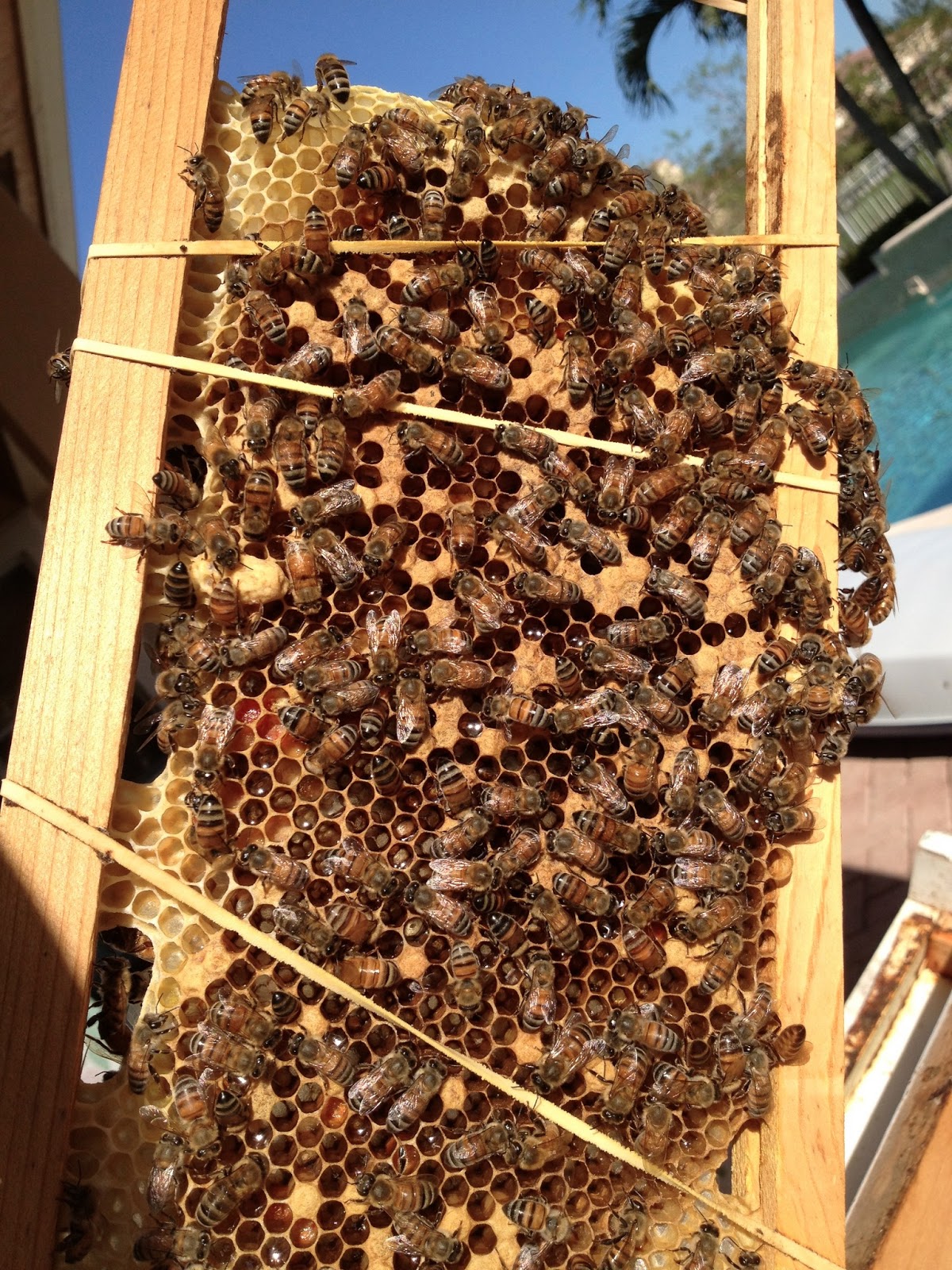
   If you're wondering why I'm so confident with Casterly Rock, just take a look at this frame. This is a thing of beauty right here! That whole top row of white is finished honey, the row of orange underneath is pollen/bee bread (a fermented mixture of nectar + pollen + bee enzymes) that is used to feed the young, the entire rest of the frame progresses from eggs in the empty looking cells, to young larvae, to mature larvae, back to young larvae, and then finally more eggs. I can't wait to see this frame all capped up. It's going to be an almost solid sheet of capped honey, filled cells of bee bread, and capped brood.
 
Notes: 
Pests: none, Brood: 5 frames (Eggs/Larvae/CappedBrood/Drone, another frame given to Dothraki) with solid laying pattern, Honey: 2 frames (Honey only), Syrup: 3 mason jars in one week

Dothraki


   FINALLY, the Dothraki have a Khaleesi (queen)! I knew that virgin queen from the other week had been stung to death! Doubts were starting to creep in that maybe she hadn't been stung, that maybe she was their victorious queen, but had been injured/gotten sick while on a maiden flight. Nope, that virgin queen had indeed been on the losing side of the May 2013 Khaleesi Thunderdome.

   Sorry for the poor picture quality by the way. I'll get a better picture in two weeks. I'm going to leave them as undisturbed as possible, that way the new queen will feel secure and be confident going full steam with egg laying. I didn't see any eggs today. However, queens start out laying slowly, and ramp up their rates of egg laying as they mature. I also didn't inspect her frame (the last frame actually) all that thoroughly, because I didn't want to spook her into flying off.

   Lots of honey built up by these girls, lots of pollen stored away, and lots of drawn out comb (mostly thanks to pulling from Casterly Rock). Funny thing is that two days ago I had pulled a full frame of brood + eggs from Casterly rock to give to the Dothraki. I had inspected this hive for a queen and hadn't found one. So apparently she must have been out on her maiden flight or I simply hadn't found her. No clue. I was extremely surprised to see her today!

   The Dothraki are set to start exploding in productivity. I did see three hives beetles in there however... I attribute that to having low numbers until only recently. Two of them were crushed, and the third one escaped behind a frame before I could put down the frame that I was inspecting. I'll get that little bastard next time.

Notes: 
Pests: Three hive beetles (two dead, one escaped deeper into the hive), Brood: 4 "Super" frames (Larvae/CappedBrood), Honey: 1 frames (Honey and Pollen), Syrup: 2 mason jars in one week

Ren


She thinks hive inspection day is great. It means at least an hour of hunting lizards and running around. Time for another nail trim too!

Wildlings


   These girls are doing really well. They've been stockpiling honey and pollen for entire time that their queen was maturing. Pictured above is a "free form" Super frame of 90% capped honey. It's tempting to steal a small piece to try it, but it's not worth setting them back at all. Not to mention that they've been fed syrup pretty regularly, so chances are it wouldn't taste very strong in comparison to legit honey.

   Speaking of feeding... I'm going to have to build a real hive stand for the bee yard. I noticed that they were draining their feeder rather quickly. Upon closer inspection there were some ants walking around near the entrance. After pulling the feeder jar out I could see a good twenty or so fire ants on and around the feeder. Argh I hate ants! They weren't invading the hive since there were cracks in the plastic feeder that they could fit through, so no problem there, but that's food for MY bees, not you ants!

   So how to fix that? It's pretty simple. I'm going to have to go pick up some 2x4s to assemble into a long frame with six legs (two on each end, two in the center), and sit each leg in a can of water & motor oil. That way the ants won't be able to cross the liquid and climb onto the legs of the stand. It's just going to take some elbow grease to make it happen.


   The Wildlings have also been drinking again (typical Wildlings), and have gone to work drunk. Look at this crazy comb that they've built. Pretty awesome to look at, not so awesome in terms of functionality and organization. I had to scrape it off with my hive tool and set the pieces at the hive entrance for them to clean out the collected nectar. Other than that though, great looking hive! I set them up with a Deep as their second stage, the first stage is a Super. Once they start filling out the top then I can change around the order, with the Deep on bottom and the Super on top. THEN I can move the queen into the Deep, with the queen excluder on top of it. That way the brood comb can hatch out completely, and the queen can continue laying down below. Once the brood comb in the Super is completely hatched out I can remove it completely, and put a second Deep on so that it goes Stage 1: Deep, Stage 2: Deep, and they'll have their full strength hive body. Everything else on top will purely be for clean honey production. 

Notes: 
Pests: One hive beetles (crushed), Brood: 5 frames (Eggs/Larvae/CappedBrood) with solid laying pattern, Honey: 2 frames (Honey only), Syrup: 1 mason jars in one week

Winterfell


   Winterfell has drones! How cool is that?! The one in the center of the picture with the fat abdomen, larger wings, and eyes similar to house fly is a drone. Just think of those massive eyes as the goggles of a fighter pilot. Their whole physiology is based around mid-air acrobatics in order to be the first to link up with a virgin queen. Even if afterwards their whole "situation" gets ripped out of their bodies. Afterwards they'll die... still a better love story than Twilight.

   Their feeder was removed from inside the second Deep and replaced with the last three frames. Other than that, I didn't bother them too much. They had spread well throughout the second Deep and had a good amount of surface area covered when I took the inner cover off. It seems the feeder encouraged them to start moving through the queen excluder too, since there was a bit of wax buildup on a few second stage frames. They still have three frames in the first stage to fill out, so I'm not too concerned about it. The main purpose of the second stage being put on this soon is to inhibit swarming. 

   Swarming is when the original queen takes off with half the hive to start a new hive, while the remaining bees raise a new queen to continue the original hive. Swarming will occur when they run out of space to expand, and feel "cluttered". So to avoid that it's best to add another Deep or Super on top when they've reached 7 frames. That gives the beekeeper plenty of leeway instead of waiting an extra two or three weeks, and then it's suddenly critical that the next stage is added immediately.


   I didn't do a thorough inspection of them, since that would require taking off the lightly populated second stage, taking off the queen excluder, and then going through the first stage. There is already one dead hive directly across from this one, on the next pallet over. That one has pretty much just been a beetle farm from the looks of it. If the covers are kept off for more than ten minutes then I'll start getting beetles flying over to land on the lip of the hives, it's disgusting. I'll be moving all of my hives to a different area of the property once the stands are finished. 

   Winterfell is strong enough now that there isn't much to worry about with them, outside of ant infestation and varroa. So they'll be fine to go for another week without invasive inspection. I did, however, see one beetle land at the entrance after placing a piece of nectar/honey-filled stray comb at the entrance for the girls to clean out. The smell must have attracted the beetle. Winterfell proved it's mettle though, with the guard bees blocking off the beetle from the entrance and chasing it up the exterior of the hive. I grabbed it as soon as I could and crushed it. 

Notes from gazing down through the queen excluder:
Pests: One hive beetle (crushed, attempted to enter by the front entrance, was blocked by guard bees and chased up the side of the hive box where it met it's fate), Brood: 6 frames (Eggs/Larvae/CappedBrood/Drone) with assumed solid laying pattern, Honey: 2 frames, possibly 3 by now (Honey only), Syrup: 1 mason jar in three days


   This has truly been an excellent week for the bees. Two new queens in two weeks, second stages added to both Wildlings and Winterfell, Dothraki having massive stores of bee bread for the new babies, and Casterly Rock being ready for a move to the bee yard where they will receive their second stage. I can finally sleep completely soundly without any stressing over queenless hives falling behind.

   Not just that, but a good friend of mine has decided to help me out with a logo for the upcoming wax products (lip balm, etc) and honey. I can't wait to show her design off! Exciting stuff! 

Monday, May 27, 2013

Hive Inspections Pt.2: Re-Re-Queening & My Face Is Over 9000


   The last week and a half has been pretty good for all of the bees, except for the Dothraki. They've been having some issues. Well, either that or they're being very secretive about how well they're doing.

   Upon last hive check, I discovered that their queen cells had hatched out. Also spotted was a potential virgin queen. This week though, there was no queen anywhere, and not just that. There were also a set of NEW queen cells, all of which had been sealed. Curiouser and curiouser.

   One thing that did come to mind was how last inspection's virgin queen was just so scrawny. It didn't even click that it was a virgin queen until a few days later. She was so tiny that, at the time, I had thought she was just a weird looking bee who had developed improperly. Just to be safe, I made sure to skip a full inspection on them to not spook her.

This Week: Dothraki


   As usual, Thursday morning I had gone outside with my coffee to watch them start their day. This time though, there was a small commotion at the entrance. Two bees were dragging another bee out. One bee turned back at the lip of the bottom board, and then the remaining bee flew her captive down to the bricks. The captive bee didn't seem to be struggling at all, and the worker proceeded to hop another six feet with her "cargo". That was a bit strange and caught my interest. Normally they'll dump their dead a max of two feet away. This must have been a special prisoner.


   It was a virgin queen. The first thing that highlighted her as a queen was the honey colored abdomen with a dark tip and no black bars. 


   The next indicator was the classic queen thorax. If you look at the picture above, on the left side is the virgin queen, and the right side is a worker bee. Notice how the thorax on the queen is much more pronounced, has a very light covering of hair (most of which can only really be seen from an angle), and has a defined circular shape in the front half. 

   Also take note of how different her primary (outermost) wings are compared to the worker's. The worker's wings are noticeably smaller in width for the last third of the main wing, while the queen's wings are more wasp-like and much more broad at the tips. I'll have to do some research on the wing details, but I would assume the queen's are for fast, agile aerobatics to avoid predators while on maiden flights and swarm migrations.

   As for the health of this virgin queen, I'm thinking she was in poor health and the workers killed her by stinging her. She wasn't convulsing, it was more of a twitching. The tiny joints in her legs were twitching and vibrating as if she couldn't control them, which says "venom" all over it.

  Honey bee venom is called "apitoxin" and is primarily an anticoagulant. According to Wikipedia's entry on apitoxin, two components of it are apamin and phospholipase. Apamin is a mild neurotoxin, and phospholipase is an enzyme that breaks down phospholipids (cell membranes). Both of these would certainly cause degradation of motor functions as characterized by this virgin queen's symptoms.


   I felt bad for her, but the bees know best. From my perspective I have no idea if there is something wrong with this queen, but from a bee's perspective there could be some glaring problem with this queen. She is a very pretty queen though, the picture doesn't do justice. I'm going to start a pin board for queens, and to create a sort of catalog of different queen colorations. Inevitably, there will be queens that produce very irritable bees. These will have to be killed so that the workers can raise a new, nicer queen. So instead of just pinching (squishing) them, it'd be neat to just collect them.

   Anyways, after taking some pictures I went back and inspected the hive. There were seven new queen cells, and a good number of capped brood had hatched out. The hive was very busy with workers packing away pollen for the new larvae and bigger population. Again, I didn't see a queen, and the current queen cells were all sealed up with no holes. So I really don't think that virgin queen had been stung to death by a resident queen from the previous hatching. Otherwise, the resident queen would have chewed through the new queen cells to kill the occupants.

  Just to be safe, I removed an unused frame of empty foundation from the Dothraki hive and traded a frame of brood from the new feral hive. After giving them the new frame they were closed up. I kept it all as brief as possible due to them already being stressed without a queen. I'm crossing my fingers for this next wave of queens, mostly so that I don't have to keep pulling brood from the new feral hive. 

Notes: All comb related indicators are considered false due to constant trading of frames, Brood: First set of queen cells hatched (observed ejection of dying virgin queen with failure of fine motor control), Second set of queen cells intact (x7)

New Ferals


   These girls are doing awesome! It's incredible just how quickly these bees haven taken to their new home. Not only are they exploding with activity at the first indication of the sun rise, but they're chugging syrup like mad!


   One way to tell how much construction going on inside a hive is by how how much dust they're tossing out. Like any busy construction site, there's wax scraps and debris to get rid of. Just look at he picture above. There's definitely some heavy lifting going on inside this hive!

   Prior to taking a frame of brood, these girls were at 7 frames of bees + comb. I was going to stack a second Deep box on top to make a two story hive body, but after the frame removal I think they're going to need a bit more time. This definitely calls for a trip to South Florida Bee Supplies for more frames and boxes though. They'll be moved to the bee yard this coming Friday.

   Oh! Almost forgot. The bottom board that's currently on them is a pretty old board that I bought on the cheap. It doesn't have proper spacing for an entrance feeder or for an entrance reducer. So I had to improvise a bit to come up with a good feeding solution.


   What I ended up doing was just taking two pieces of wood and forming a brace for the jar. Do not use this method with anything breakable unless the hive is very heavily sheltered. This area of the patio is sheltered on two sides by the house, so I felt comfortable using a mason jar for this. 

   This left a nice little sheltered area that channels the bees toward the jar. I also put a drop of honey right in front of it so that the bees could hone in on the smell. From everything I read, sugar syrup is odorless. That would explain why ants aren't sneaking in to steal syrup. Therefore the honey is pretty necessary, at least in a small bee yard. In a large bee yard there are just so many bees that it's almost guaranteed that someone will find the feeder by chance, and then call for backup. 


   Sure enough, they found it within 2 hours. Ever since then they've been chugging syrup like mad, emptying jars within 48 hours. It's pretty impressive! They also have drone cells which means they are in ace shape. A hive won't create drone cells unless they are very "happy" and unstressed.

Notes: 
Pests: Two hive beetles (both dead, assumed to have hitchhiked with cut-out comb), Brood: 5 frames (Eggs/Larvae/CappedBrood/Drone, one frame given to Dothraki) with solid laying pattern, Honey: 2 frames (Honey only), Syrup: 2 mason jars in one week

My Face


   This sting is really bringing out my Mandarin genes. When I asked friends to rate my Asian level on a scale of 1-9000; it was a conclusive 


   So again, wear your veils please! 

   This updated ended up being a lot longer than I expected. Mostly due to just interesting bees are, and how much change has been going on with these bees. Then again it's Spring, the best time to bee a bee! See what I did there? Tomorrow's post will be about the Winterfell hive mostly, as well as relocating my bees to a different part of the bee yard property and a cut-out from a trailer home. Stay tuned!

Edit: This post has now made some asian dating sites pop up in the Google ads hahaha. Silly Google.

Thursday, May 16, 2013

First Solo Cut-Out: Third Feral Hive Recovered... And It's A BIG One!


This has been one intense week. Monday was my first day of summer classes, spanning from 10am to 9pm. Three classes, each several hours long, with one break of 1 1/2 hours, and then a break of 2 1/2 hours. Rough. I need to start packing a fruit salad and yogurt as an energy snack. As if that wasn't enough, I got an email in the morning about a cut-out that was needed that afternoon. Any reasonable person would have been tired, and would have asked to see if it could be done the next day. But I was too excited to be reasonable. This would be my first cut-out to be done by myself!

I headed straight from Biology lab to the property by Palm Beach Gardens. Upon ringing the doorbell I was introduced to a really nice woman who, as it turns out, used to keep bees while living in France. She was very happy to have the bees rehomed to a "backyard" situation, where they would be looked after, instead of the large tree pot that was their current home.

As we walked out to the backyard, she described how the bees had originally arrived. They had shown up approximately 4 to 6 weeks before, and then decided that the pot would make a great home. It was large and roomy, had a nice dark interior, and small drainage holes around the top for small, easily guarded, entrances. "No big deal," I thought, "I'll just pick it up and move it into the open. Then cut out the few panels of comb to place into a nuc box, then be on my way...".


NOOOOOPE. I would most definitely NOT be right along on my way. These panels of comb were MASSIVE. I don't mean "Huh, that's some big comb.", I mean "WOAH... this is going to take a few hours...". An important lesson was learned this day: Don't ever underestimate the honeybees. I should have brought a complete set of ten empty frames. Unfortunately I only had five, and the location was a full hour away, in zero traffic, from my house. I also had work the next day, and then another full day of class. So there was no way to come back the following day, or even the day after that. I was going to have to make do with what I had.

The top of the tree pot was a good 3ft wide and just as deep. There were nine panels of comb, with the largest ones spanning from the top of the pot to the bottom. It wasn't just comb that had to be dealt with either, there were a serious number of bees in this hive!

Now, I haven't seen a huge amount of hives up close. But this comb was by far the most beautiful, perfectly filled comb I have ever seen. If you look closely at the picture above, you can see the left side panel quite clearly. There is a half circle of capped brood, at the center, that is in the process of hatching. After this there is a very clean arc of eggs (looks like empty cells), followed by another perfectly laid arc of young capped brood, and then after that is shiny fresh wax filled with eggs (which you can see more clearly on the edge of the right panel of comb). This comb was stunning. I wanted to save as much of is as I could. If only they made curved frames!

After wondering just how the heck I was going to do this for a good five minutes, I got started. The comb was so long and new that they all drifted to the sides after flipping the pot over. However, at least none of them detached or broke off. Mike taught me that the proper way to go about this is to figure out which way the comb is facing, then flip the container over with the combs running away from you. So when flipping, you should be able to look straight down the spaces between combs. This follows the structural strength of the comb to avoid breakage. If you flipped a container with the comb running lengthwise, with the end of each panel at one of your hands, then there's a good chance of panels completely falling off and onto the ground.

It was extremely messy work and I wish I had taken more pictures, but, since I was doing it all solo, there was no way without being significantly slowed. Thankfully the bees had replaced hatched brood with honey and pollen along the tops of the panels. That way I wouldn't have to be so concerned about salvaging under-developed comb that only housed minor amounts of honey or brood.

That being said, I still had to cut into that perfect comb. It was mentally hard to do, putting hive tool to immaculate brood comb. Each panel got cut up into two smaller panels that would each be rubber banded into an empty wooden frame. Seeing the developing, bee-shaped pupae falling out and being crushed was really tough... but there was no way around it. Not just that but I had to be extremely careful with the whole thing. Careful to damage the brood comb as little as possible, careful to not crunch any adult bees on accident, careful not to be too rough and damage the queen without realizing. It was a lot of self-reassurance without having Mike there to ask questions to.

Eventually, I got all of the comb either transferred into frames, and what couldn't be framed got bagged up for wax reclamation. As I was pulling out the last three panels, I got a glimpse of the queen. She was quick though and disappeared into the mass of bees before the queen clip was ready. I was ready to start sweating about finding one queen bee among 10,000 bees. All of which were randomly walking around the pot and supporting wheelbarrow. However, just as I got the last panel out and returned with the queen clip... there she was! She had somehow made her way up from the bottom of the pot to the inner lip, and flashed over top of the other bees for just a second. That second was all I needed and I was able to clip her on the first attempt. Not to pat myself on the back, but picking out the queen is starting to become an unconscious reflex. All of this cut-out experience and hive checking is building some great experience!


Once she was clipped it was just a matter of placing her in the nuc box, setting the nuc box about 10 feet from the wheelbarrow and pot, and waiting. I dumped what bees I could from the pot onto the top of the nuc box, then put it back on the wheelbarrow. Then it was time for a dinner break.

I hit a great local Cuban restaurant, and then returned about two hours later after dark. All of the bees were off the wheelbarrow and in the nuc box with the queen. Perfect! There was still a giant beard on the front of the box though, due to the sheer size of the hive. I ended up just scooping them off the sides with my hands and putting them on top of the box. It was dark so they just stayed clustered up there, then it was off to the car for these bees.

After arriving at home, I went to the trunk to get the bees out and... crap, there were bees bearding from the entrance of the nuc and onto the walls of the trunk! I tried to get as many as I could out, but knew they'd have to be handled tomorrow. At night they seem to just go into stasis and ignore most of what's happening. The trunk would smell too much like the queen and they wouldn't follow her immediately to the backyard. So the nuc was taken to the back yard, set up into a full sized Deep hive body, and I went to bed.


And this is what I woke up to! I tried to manually get the bees out for about fifteen minutes, but there were just too many inside the trunk and inside the cab of the car. What ended up working was bringing the empty nuc back and placing it next to the car. It smelled like the hive and queen, so they quickly moved over into the box. The ones inside got heavily smoked and almost all flew outside on their own. They caught the scent of the nuc and went in, leaving only a few stragglers inside who got shooed out by hand. Success, hive #4 has been successfully relocated to the backyard for rehab!


I didn't have a spare telescoping cover (forgot to pick an extra up in Miami), so I cut a piece of pine board into a nice size for the hive. The triangle of wood is just heavy cedar to weigh down the cover. Right after they were checked on, I had to go to work. So I did that and then came home to see how the girls were doing. They were gentle the whole time and will let me sit next to them without issue. The first day was all orientation flights and sending out forager scouts. It was a constant cloud of 25-30 bees in the airspace around the hive, many of them departing and arriving from the surrounding area. The area around my home must be great, considering many of them were already returning with very full pollen baskets.


I also noticed that the Dothraki hive had extra guards at the entrance, and that there was a lot of traffic coming and going from their entrance. There's no way to visually be sure which hive the bees belonged to, so rather than risk the Dothraki getting robbed, I reduced their entrance to an opening of about an inch and a half. Afterwards they seemed to feel more secure and posted less guards. One interesting thing to note, however, is that at night they pack the entrance with "sleeping" guards so anyone entering would have to touch them. The new hive also has bees at their entrance at night. Both of these are new behaviors that I haven't seen before, so my hypothesis is that they post extra guards at the entrance when there is another nearby hive (possible competition).


I was also able to record some high definition video of the new hive's activity of their first full day. There's a lot of traffic coming and going for orientation and harvesting. There is also some fanning going on, although I'm not 100% positive whether it's ventilation fanning or pheromone fanning. It'd be great if someone could confirm which it is. I want to say it's pheromone fanning since there were only three bees total who were engaged in fanning. However, none of them had their abdomens pointed upwards to expose their pheromone glands. Three bees just doesn't seem like it's going to accomplish much in terms of air conditioning, so I'm a bit stumped on which it could be.


I highly recommend watching in 720p/1080p in full screen!

All in all the bees seem very happy. I released the queen at around 11pm on the day following the cut-out. After class yesterday, I checked back and the bees are still there. So they're happy, the queens happy, and they all approve of the new home. I'm thinking of moving them to the bee yard later today or tomorrow.

The only thing that worries me is not having a proper cover for them. I'm not worried about beetles that much. They were living directly over the dirt and had only two beetles that I could find, both of which are now dead. These are awesome bees, super busy, very friendly and patient, and I'm completely confident that they will be my strongest hive. If this queen keeps her immaculate laying pattern then this hive is going to be booming over the next month. They'll definitely need a second Deep box in two weeks, then another month or two to fill that up. Once that's done, it'll be time to add a honey super for my first ever frames of honey! After pulling a bit of honey, I will definitely be splitting this hive to start a new colony. Exciting stuff!


P.S. Regular readers may have noticed that some ad banners have popped up on the sides. I'm not a fan of ads, but the Google AdSense ads actually promote reputable beekeeping suppliers (ex. Mann Lake, Dadant) as well as some companies selling package bees. There is an ad that pops up every now and then for RoundUp (Monsanto), and I am working out how to specifically block that ad. AdSense allows blocking specific advertisers and, as soon as I know how, that ad won't be showing up here.

A click every now and then would be a nice help towards offsetting equipment costs for rehoming all of these bees. I'm just a backyard keeper for right now, learning everything I can about honeybees (majoring in Entomology, hoping to specialize in honeybees and social insects), and rehoming what bees I can as a free service in exchange for hands-on experience. My promise to you guys is that I will never put pop-up ads or obnoxiously place banners anywhere. Thanks for reading!

Saturday, May 11, 2013

Hive Inspections: Winterfell is feisty, Wildlings & Dothraki stage a revolution


Wow! Lots of changes in all three hives since last week. I did the inspections on Thursday in order to keep a solid inspection schedule. I feel this is very important when it comes to beekeeping. There are already so many distractions in modern life, and without committing yourself to a consistent schedule it will be very easy to fall behind. "Oh I'll just do it tomorrow, I just feel like watching tv today." could very well turn into more procrastination the next day. Just a few days is all it takes for a hive to fail cascade when at this small of a size. Now, don't take that to be scaremongering. If anything it should be encouragement to be a responsible caretaker of your bees, and you should already be super excited to visit them anyways! It's amazing enough to just watch them coming and going, and it's even more amazing to open up the hive to see what your bees have accomplished under your care!


Dothraki Hive

So it had been exactly a week from when the Dothraki bees got a new frame of brood for queen production. I inspected them first, since they're on the back patio and I don't even need to leave home for that. All of the queen cells are capped up, there's plenty of open honey with a good percentage already capped, and a really nice bouquet of pollen as well (which you can see in the very top picture). The pollen ranges from completely white, to pale yellow, to neon yellow, and then both dull orange and neon orange. There are foragers coming and going at a constant rate. I'd say about one in every eight bees is returning with their pollen baskets loaded. That's a pretty good ratio it seems, judging by the good stored in the hive. All of the queen cells have been sealed up as well. So in another week and a half or so, there should be a duel between the first two queens to decide who rules.

Apparently there was a drone cell on the frame that got transplanted from the Widling hive. I caught an awesome video of him getting kicked out. At least, I'm 75% sure it's a drone due to being a bit larger and darker, but it may have been a robber/stray bee as well. I didn't think to check at the time if it was a drone, since they don't have a current queen to have been producing them. The bees are also chugging syrup and building up lots of comb. I'm thinking they're taking the readily available food and only sending a few out as foragers due to smaller numbers, only one frame of brood, and it being riskier to collect nectar than it is to just hit up the entrance feeder.


I recommend watching in a high definition and expanded size

Notes: 
Pests: None, Bees: 2 frames of bees, Brood: 1 frame (L, CB, 4 sealed Replacement Queen Cells) with scattered laying pattern from Wildling queen, Honey: 2 frames, Pollen: mixed well among 3 frames, Syrup: 4 cups since last week


Wildling Hive

Last week when I pulled out the frame of brood I didn't look for the queen, but I did look for eggs. Looking for eggs is the fast way to check for a queen's presence. Eggs take on three positions as they mature: straight up on the first day, leaning like the Tower of Pisa on the second day, and then a very low lean on the third day prior to hatching. I saw eggs on day 2 so that means the queen was active in the last two days. No need to find her when she's been active that recently, not to mention that nature was getting ready to douse the hive and I in heavy rain. The first frame I pulled out had about 3/4 of one side with honeycomb, nice and heavy. Then as I went to set it back in I noticed a queen cell on the next frame. Upon checking the rest of the frames, the girls have not just 4 queen cells like the Dothraki, but SEVEN queen cells on just two frames of eggs. They were solidly capped cells, and they even made a crazy trio of queen cells. Of which each is only seperated by one non-functional cell from the other. That's sort of Hunger Games'ish, training and growing right next to the same people that will soon be trying to kill you.


I'm going to guess that stormy day last week with drizzling rain eventually coming down on the open hive + the inconsistent/scattered laying pattern of the original queen had the bees decide that it was time to replace her. Too many stresses at one time to tolerate an underperforming queen. Remember that this was the original queen from their old hive too, so she was already aged. Still strange though that both feral hives have fired their original queens. These bees have also consumed less syrup than the Dothraki hive. I'm guessing that it's most likely due to them having higher numbers of foragers and a good sized, productive farm 50ft away.

So within a day or two of the Dothrakis, these 7 queens should be thunderdoming it out to decide the victor in a brutal fight to the death. At least the first 2-4 will, the winner from that will then either face single challengers as the others hatch out, or the winner of the first fight will achieve victory quickly enough that she can go around the frames, killing the remaining queens as they lay helpless in their cells.


Other than that though, the hive is extremely busy. Lots of bees coming and going, about one in six bees has pollen. They've started building up another frame with comb, which makes up for the comb given to the Dothraki. Plenty of honey is in storage, not too much capped outside of some extra capping of their original comb. Then again they've only recently built up full sized cells on the foundation, the rest has been pre-existing comb that is rubber banded into empty frames. No big deal there, they're obviously happy and getting enough from the surrounding area that they aren't chugging from the feeder. There's also lots of brand new larvae (very small, compared to the fat larvae who are about to spin cocoons) and capped brood, so I'm not worried about numbers with this hive at all.

These bees were taken from a water meter cut-out and transferred into a Super sized nuc box, so that means they're on 3/4 sized frames. I didn't want them building wax down from the frames and attaching onto the bottom board. Not only would that be an incredible pain to get the screening cleaned out, but that'd be a ton of wasted wax for the girls when they need 100% material and labor efficiency. The day before I had gone down to South Florida Bee Supplies and picked up a Super box, as well as a nuc box (to be used as a hive trap), total of 30 frames (10 Super without foundation, 10 Deep without foundation, 10 Deep with foundation), another feeder, and some queen lure. So I spent about 10mins getting them transferred from the Deep and into the Super. The Wintefell hive was used as a table, which was actually a pretty poor idea.


Notes: 
Pests: One beetled that was imprisoned between a frame and hive wall (now dead), Bees: 3 frames of bees, Brood: 2 frames (L, CB, 7 Replacement Queen Cells, minute scattering of drone cells) with scattered laying pattern from previous queen, Honey: 3 frames, Pollen: mixed well among 4 frames, Syrup: 2 cups since last week


Winterfell Hive

Just look at that fresh, beautiful pure comb being built up on that foundation. That's frame seven, counting from the left side of the hive with entrance facing forward. These girls have frames two through seven built up with comb! They originally only had three frames built up with the fourth only just starting to be developed with small flecks of wax. All that in just three weeks. These girls are busy!


They also got a little fiesty haha. I hadn't given it much thought at the time, but all the vibrations and bumps from using the Winterfell hive as a table had gotten them nervous. It sounds obvious now, but it wasn't under 90F in the sun and I'm trying to be quick in order to not let the new wax get soft. Using only a veil for protection, I lifted the top off the Winterfell hive and started inspecting frames. I got two frames in and, due to sweat, had to suddenly tighten my grip on a frame in order to stop it from slipping. This jolted the frame and a single bee shot out like a little missile, buried herself in the top of my hand, and then grinded the stinger in deeper like she was at a club in Miami. Now, I'm no stranger to painful insect stings. Fire ants are the devil incarnate, but they're tiny and easy to brush away. It's a whole different thing when you have a full sized bee on your hand, and through the thoughts of "MOTHER OF GOD, IT BURNS!" it seems massive. It was definitely more of a surprise factor than a pain factor. I've never been stung before, so it was a bit more than I expected. That coupled with the visual of the bee on my hand, and the natural fight or flight instinct to run away from the danger, had me pretty surprised.

I did have a full frame of bees though, and dropping that would only make things worse. I lowered a corner so that it rested on another frame, then quickly (don't do that, be slow and smooth) pulled my hand back to brush the bee off. The fast movement + danger pheromone from the sting attracted three more bees right away. They started buzzing the stung hand as I lowered the frame back into the hive. After putting the frame back, I tucked the stung hand into my armpit to minimize the pheromone release and walked away from the hive, back to the van (about 30ft away).

For those that don't know, the stinger is coupled to a poison sac, that poison sac is attached to the bee's insides. The stinger is actually two serrated barbs, with the poison running down the channel between the two. Upon stinging, the whole package is torn out of the bee and the bee will die after a short time.
It really didn't hurt that much to be honest. It's just the newness of it and the reactionary "Oh crap!" of the primitive part of the brain. I ended up watching the poison sac pulsate for a few seconds because it was neat, then scraped it out with a credit card.

No time to lick wounds though, there's work to be done! Unfortunately my smoker was being a pain in the butt, so I just tossed on the jacket and gloves to get the rest done. The leather of the gloves will cover up the smell so that the bees don't get stressed from smelling the alarm chemicals.


Back at the hive, the next frame was the main honey frame. Wow this was heavier than I remembered. The outer side, which had nothing before, was now solid honey! As tempting as it is to steal some honey, they really need it to continue expanding at maximum efficiency. Plus I picked up some avocado honey from the supplier visit, can't wait to dig into that once my tongue heals up from it's hot sauce chemical burns. Long and unrelated story, but I tried the hottest sauce at Tijuana Flats, ow. Next up was what used to be a honey frame. The inner side now had eggs and capped brood. Just look at that solid laying pattern! That's what a healthy queen looks like, solid sheets of young from the same timeframe of laying. That really is beautiful to see, and photos just don't do it justice. Also, that funky looking, protruding circle cell is a drone cell. It's just being built off of a normal sized cell. Drone cells are good at this stage! This means they are happy with how much food they've built up, the health of the hive, and are confident in their queen. Drones (males) do no work whatsoever, they just sit around eating and being freeloaders. They do fly around looking for a queen to mate with, but if they're kicked out then they will go to a Drone Congregation Area to hang out with their bros.


This is the frame opposite of the one above, frame three. This frame has been freshly drawn out with wax and has a freshly laid sheet of eggs interspersed with a very small scattering of late stage larvae (the white filled cells). It looks like the queen passed over this frame while it was being made and decided a few cells were built up enough to lay few eggs. Five or six days later she came back to this frame, nodded her approval, and laid down a sheet of eggs. I'm actually really happy with how this picture came out and am probly going to make it my background. I love the angles and design of the comb, so precise but still organic. The lines formed in the corners make it a bit trippy too.

I did find the queen herself, not because I was looking for her, but just because there was a clump of bees on the side. She always has an entourage so I briefly scan any clump of bees I see. It's also just getting easier to pick her out by subconscious recognition.

Overall, I'm VERY very happy with these bees! Even if it was the "domesticated" bees that stung me first, and not the two feral (and supposedly more africanized) bees haha. I saw one hive beetle, but I'm pretty sure that's only due to having walked away with the cover off after getting stung. The beetle got contained to the lip of the hive by the bees, where I happily crunched it with my thumb. After crushing it in front of the guard bee assigned to it, the guard seemed to be like "Oh, hey thanks, time to take a break" and then just walked back into the hive without inspecting my thumb. It seemed pretty funny in the moment, maybe it was just being dehydrated, shot up with bee venom, and on an endorphin rush.


Notes: 
Pests: One beetle (dead, most likely from leaving cover off for a few mins and walking away), Bees: 5 frames of bees, Brood: 5 frame (E, L, CB, Drone) small number of drone cells, Honey: 3 frames, Pollen: mixed well among brood frames, Syrup: not currently being fed

Friday, May 3, 2013

Dothraki Hive: Queen Cells!


YES! The girls have built four queen cells on the frame that I transplanted from the Wildling hive! It looks like they'll soon be queenright. It takes 14 days for a queen to develop, from egg to virgin queen. If I remember correctly then it's between days 15 and 17 that she goes on her maiden flight, mating with local drones. Then she'll begin laying eggs either that day or the following day. Disaster averted!


The "Hived" Swarm: Update + My First Real Test As A Beekeeper


There's some good news, and some bad news about the Dothraki/patio hive. I've also run into my first real "challenge" as a beekeeper. The good news, is that I'm confident that this hive is going to be strong. The bad news is that they've taken one step forward and two steps back. More on that later on in the entry though. Going to walk through this in a chronological fashion.


Friday the 26th of April, 2013

Happy bees! The captured swarm has chugged almost a full cup of sugar syrup and I was advised not to disturb them very much. I figured the best way to let them bee was to just keep an eye on them while monitoring sugar syrup consumption, since syrup consumption = wax production. They had zero comb to start with so the girls were provided with three frames of wax coated black plastic foundation to build off of. According to the syrup chugging they were getting pretty hungry and were building like mad. At this point, the queen was also still in the clip, suspended between two frames. So far so good I hoped!

That night I headed straight up to Kissimmee to stay with my good friends, Osy & Brian, for the weekend's Nihon Ken Forum meetup. The NKF is a place where Japanese dog enthusiasts aggregate to talk about their dogs (five spitz breeds: Japanese Akita, Kishu Ken, Shikoku Ken, Kai Ken, Hokkaido Inu, and Shiba Inu) and there just so happens to be 6-7 of us in Florida. We usually try to meet up every 3 months and we're all 24-32'ish if I remember correctly. Here's the gallery if anyone is a dog person. I didn't get back until late late on Saturday night. So there wasn't a chance to check out the bees or release the queen from her clip.

Saturday: Away in Kissimmee/Lakeland, FL.

Sunday the 28th of April, 2013
 

Sunday morning I slept in a bit and woke up at 10am. As soon as I woke up though, it was straight outside in full gear. No smoke was used, these bees are really gentle. I had been observing them before the trip by sitting in a chair with my knees about 2ft or 2/3 of a meter away from the entrance, wearing nothing but a swimsuit. They didn't mind at all as long as there was no large, sudden movements. I could stand up and walk around without them coming by to inspect me at all, but if I stood up quickly or ran over there would be a guard bee coming up to see what the commotion was. Even then, just standing still or sitting calmly would make the guard be go back to it's regular post.

I did get fully kitted up for opening the hive though, since their temperament for inspections was still untested. Gloves, jacket/veil, and a hive tool was the equipment used. I didn't use any smoke, wore shorts, and no shoes. Partly because I'm forcing myself to get more comfortable with the bees. I still can't go in and move frame with my bare hands with 100% full confidence yet. The battle with my subconscious reaction to want to pull my hands away is still being fought haha. It's pretty funny to reflect on actually. My subconscious thoughts are so strong as to practically be manifested in actual though. It's really weird, and reading this probably sounds all sorts of crazy. But for any readers that aren't beekeepers, it's only something that you'll gain any understanding by actually putting your bare hands on a frame full of bees. I've never been skydiving or bungee jumping, but I would imagine it'd be the same feeling at the moment of exiting the plane or jumping off of a bridge for the first time. Everything in the primitive section of your mind is screaming "NO DON'T DO IT!".

Anyhow, back to the bees! Nothing seemed all that new upon first lifting the lid. There was some smatterings of white wax along the first, outermost frame that I lifted out, a good sign. Then I went ahead and lifted the queen clip out, those bees sure had been building wax... they practically built a whole 1/8 frame of comb on the queen clip itself! The wax was an incredible pearly white, almost fluorescent in the sun. Unfortunately that wax wasn't going to be very useable whatsoever. It couldn't be rubber banded or squished into the foundation. That would result in some crazy comb that was way too far off the foundation, ruining the ratio of "bee space" between the frames. In hindsight I probably should have just rubber banded the clip directly onto the side of a frame. That way they would have built directly around the clip and on the foundation itself. I brushed the bees off the clip and removed the wax, putting it into a sandwich bag for future melting.


I gently squeezed open the clip and the queen slipped out immediately, scurrying down into the frames. Another observation in hindsight, I was definitely too rough with the frames after releasing the queen. I was nervous that she might fly away and also a bit excited to be releasing my first queen. So one or two bees got squished between the frames and the box while inspecting the remaining two frames. Dead center in the above picture is the queen. A solid gold abdomen with no stripes, no fur on the top of her thorax, and larger "delta" shaped wings. Very pretty!


After quickly inspecting the two remaining frames and photographing the queen, the nuc box got closed up. Then that was it for the day.

Tuesday the 1st of May, 2013


I woke up and went outside to watch the bees as usual. It's turned into my morning "ritual" while waking up. I'll let Ren outside to do her business while I brew up some cafe cubano, then head outside to watch the bees as my brain brings itself online.

After a few minutes I noticed one of the bees was on the edge and just hanging there. It was definitely still alive, but just sort of... hanging there. It was lengthwise along the front edge of the landing board, with it's left legs splayed straight out, gripping onto the top edge. The right set of legs were arranged in a normal upside down V shape, bracing itself against the flat wood. "That's strange..." I thought. Looking down I noticed a dead bee under the landing, and as I looked away from the hive there were even more dead bees. There were about 5-10 dead bees that were arranged in a scattered pattern away from the hive entrance. 

The first lesson at the Palm Beach Beach Beekeeper's Association workshop was don't pick up bees on the ground and help them back into the hive. It's a nice sentiment, but sick bees will exile themselves from the hive. By sacrificing themselves they keep sickness out of the hive. I may be wrong with the first assumption, but I assumed it was one of two things. Either they were bees that were of the same age and had reached the end of their lifecycle in the same 6 hours, or there was a sickness that killed them. 

The first thing I did was check the hive externally for signs of sickness. That would be brown/black streaks across the exterior of the hive where bees are unable to hold their waste and excrete on the hive. Observing these streaks means that dysentery is going on in the hive, which could mean several severe situations. Thankfully, there were no signs of disentery. BUT I did notice immediately that there was some sort of mold/algae growing in the feeder jar (as can be seen in the above picture). Just like any sort of controlled situation, whether medical or experimental, I decided to change the most obvious variable. That being the infected sugar syrup. I took the entire feeder off, went inside, and put some water to boil.

I boiled 3/4 of a pot of water, with the jar sitting in the water for the entire time. This way the jar wouldn't get heated too quickly and shatter (boiling water hitting cold glass). After it was all boiling I removed the jar, put it in the sink, put the wood feeder + jar lid in the boiling water for two minutes, and then filled the jar with boiling water. This way every piece of the feeding system was sterilized as thoroughly as possible. I then filled the pot up with fresh water and made another jar sized batch of sugar syrup. Feeder and jar went back on the hive, and I let them be for the day.

Thursday the 2nd of May, 2013


The next day was supposed to be nothing but thunderstorms and rain past noon, so I figured it'd be a good day to just quickly check on how the Dothraki hive was doing. Afterwards I'd go check on the new feral hive I got from doing a water meter cut-out the day before (Wildling hive, the next post) and do a regular full hive check on Winterfell (Italian-Carniolans). I went back to the hive and double checked the feeder. No algae and no dead bees, good stuff! If the bees hadn't died from mutual old age then it looks like it was definitely some bad mold/algae that messed them up. 

I tossed on gloves and that's it, no smoker or jacket. I cracked open the hive and upon pulling out the second frame I saw these queen cells... crap! Right away this was bad news. Something was wrong with the queen or she was dead/gone. 

Queen cells that are built into the comb like this are supercedure cells. Cells built for new queens to supercede the old one are built when the hive isn't happy with the current queen (infertile, not laying in healthy patterns, etc) or there isn't a queen at all. If the queen cells are built along the bottom of the frame that means they are queens being raised for swarming. Meaning the current queen is getting ready to take off with half the hive in order to establish a new hive, leaving the new queen to continue on the current hive with the remaining half-hive of bees.

I quickly combed through the other frames in search of eggs, a sign that the queen had been active in the last 72 hours. No eggs and no visual on the queen. This wasn't good, and it was going to be all thunderstorms starting in the next hour or so! It was already overcast!

I had no game plan, but knew something had to be done... and quickly! My full collection of gear may have grown wings and flown into the car with how fast I collected everything to get moving. While loading gear I came up with a plan. The clock was ticking and with the loss of 15 or so bees already I didn't think there was enough time to buy a queen. I also didn't really want a second "domestic" hive, since the whole purpose of collecting these feral swarms is to eventually interbreed them with the Italian-Carniolans.

The saying in the military is that we don't rise to the occasion, we sink to our highest level of training. In this case, I'd been absorbing everything I could on beekeeping and attended a very solid workshop which covered a huge range of topics. Including a free class on queen raising, courtesy of D&J Apiary in Central Florida. After running through a few possible solutions, I reasoned that if moving in frames with eggs worked for queen rearing on a production level, then the same could be applied to this situation. But only if I could find a frame with late stage capped brood. It's only the newly hatched, baby bees that attend to the queen and it had been almost a week since capturing this swarm. A margin of error of only a week or two wasn't very comforting when it came to the age of the Dothraki bees. Without having done solid research on backbone techniques of beekeeping, both internet and workshops/meetings, then I don't think I'd have known what to do in this situation. So if you are new to beekeeping or are about to get into it, I highly suggest that you do your homework! Granted, I don't know if this is going to work or not, but if it does then that's $25 + in the event that I have to combine the Dothraki & Wildling hives, several months avoided of hive strengthening in order to split the hive back into two hives.


I rushed over to the bee yard with the newly painted full size, 10-frame Langstroth hive to transfer the Wildlings into. They were a rather large, strong cutout of 5 "super" frames (half the size of "deep" frames). So it wouldn't be a major blow to them to take a frame from them while moving them into a full size hive body. Although, they might just build wax straight downwards from the half sized frames in order to reach the "floor" of the hive boxy. That was definitely lower on the priority list than getting the Dothraki re-queen'd (or re-Khaleesi'd). 

As soon as I got to the bee yard it started drizzling. Not realizing my smoker wasn't assembled right didn't help. It took another 15mins to get the smoker lit. It was definitely time to hurry. I didn't bother putting on the jacket. It's too limited in vision and slows me down. If I wanted to get done with everything before the big, penny sized rain drops fell then I had to be fast! The only items/clothing used was smoker, gloves, shorts, "dairy boot" galoshes, a baseball hat, t-shirt, and hive tool.

I got the new hive body over to the hive table, where the Winterfell full size hive and Widlling nuc box were set up. After setting down the new hive on some plastic painting floor liner I smoked the Widling hive and moved their nuc box onto the plastic, then I put the new hive on the table and transferred all the frames from the nuc box into the new hive body. The perfect frame was there! The center of the pictured frame is all hatched out, empty cells surrounded by capped brood, then larvae, then eggs, then bee bread, and finally, honey. I smoked out all the remaining bees in the nuc, put this frame + attached nurse bees into the nuc box, taped it up, and loaded everything back into the car. 

The skies had opened up not even ten minutes into all of this, and overall it took about 30 minutes. So by the end I was completely soaked and had been stung once in the back. It felt like a straight jolt of electricity and made me instantly stand straight up. I think that made my shirt pull the stinger out though, so there wasn't much poison injected. No after effects, no throbbing ache, and no swelling. Can't complain with having an easy first sting!

So afterwards I got home and transferred the frame straight into the Dothraki hive (now with 3 deep frames + the new super frame). As far as I could tell, the only issue ended up being a single fight at the entrance of the hive. From my reading, the commercial guys just slap both hive bodies together or dump the bees straight in when they combine hives. Apparently they work it out just fine with no stacks of dead bees, so I skipped the newspaper. I'm going to do a hive check on them once I wake up, followed by driving out to the bee yard to hive check Winterfell. So there will be another update shortly.

I think I handled it pretty well for a very panic-worthy situation. I'm just hoping that the solution I came up with works. Both feral hives have been exceptional bees and I'd hate to lose either one of them. Even if it's to combine them.

Also, sorry for the uber long post! This last week was pretty busy, but it was all one issue. I figured it'd be easier to just put it all in at once vs splitting one issue up into several posts. That way anyone else who comes across this issue could just read about it in one post. If you think it would be easier to read in split posts then I'll be more than happy to split future issues into "episodes". Just comment and let me know!